Sunday, November 25, 2012
Acrosound 20 amplifier update
The job of updating the Acrosound 20 monoblock amplifier became much easier once I saw a PCB for sale on Ebay. It's a modern iteration of the same circuit, but with all new resistors, capacitors, and tube sockets. Replacement was an easy job and with all the leads soldered into position, the amplifier fired right up on the first try. Now that's always good news.
Some new power supply capacitors are still needed, but I'll wait until I have another matching amplifier before I make that move.
Listening in mono through a fairly efficient test speaker, it's a pretty good sound amplifier. The Acro has some of that general "Class A" sonic footprint - an ease and naturalness to the music that makes tubes worthwhile. It does run quite hot, and appears to be exceeding the maximum plate dissipation of the 6BQ5/EL84, but hey, this is a cheap little tube, so no worries there. Buy 'em cheap and burn 'em up!
Review: Spica TC-50 speakers
A new house has forced me into a smaller listening room. Since the full-range sound of the UREI 813A speakers would overwhelm this new space, I decided for an interim, ultimately deciding on a pair of mini-monitors placed on stands.
The Spica TC-50 was a popular budget mini-monitor speaker from the 1980s. Featuring a sloped 45 degree front, a 6.5" woofer and a small tweeter, it is renowned for it's imaging capability. Part of this performance is from the time-aligned drivers (from the sloped front) and the special crossover with matched drivers. Of course such now vintage units suffer from aging components and drivers that are long out of production.
I bought my pair via Ebay for $250 and purchased the 29" VTI speaker stands via an online seller.
Going from a massive full-range speaker - sporting a time-aligned 604 driver combined with a 15" woofer - to a small mini-monitor takes some time getting used to. Of course the majority of this change is the considerable lack of dynamics and bass extension with the smaller speaker. It's simple physics - a 6.5" woofer just can't move the same amount of air as two 15" drivers working together. In comparison, this lack of "slam" and macrodynamics makes the Spica sound rather thin. For example, on Pink Floyd - Dark Side of the Moon, the sense of urgency as the music shifts into overdrive is essentially lost. Simpler recordings, like The Immortal Otis Redding fare much better.
However, there is one area that both the UREI and Spica meet - it's the driver consistency - that sound of being cut from the same cloth. Much of that has to do with the time-alignment since the output of the drivers meet the ear at the same time. It's a hard effect to describe, but you know it when you hear it. This is part of the reason that I enjoy KEF Q series speakers.
Anyway, at reasonable levels treble extension is fairly non-irritating though lacking in the best shimmer and detail. The Spica does sound slightly tilted in this range, though part of that could be the comparison to my previous speakers.
The midrange is the strongest point - though not quite in electrostat territory, it's also no slouch in this department. I tend to think "Poor man Quad ESL-63" performance. This leads to good soundstage width and depth, though my old Magnepan 1.6QRs and even the UREIs, with their massive box, had a more realistic scale. Vocal presence is quite good, though not scaling the heights of the best I've heard. However overall coloration is still quite low - low enough to be called 'audiophile'. A good example of the soundstaging depth and relative neutrality can be heard on Willie Nelson - Stardust where the location of the instruments and the vocalist are easily determined.
Bass, as to be expected, is the weakest point. A decent subwoofer here would improve the sound, freeing the woofer from doing the heavy work. Stock, it's sort of there, not going particularly deep. I've heard more extension from the little, but thoroughly modern, KEF iQ30, which coincidentally also sports a 6.5" driver.
So what to think of the Spica TC-50? It's a good little budget design that may have been a real champ in earlier days. If you come across a pair for a good price and they haven't been modified, then go ahead and take a chance. Having said that, a few more dollars will get you a KEF (or other) monitor speaker that will have a warranty, new capacitors, and drivers that can be replaced if you get a little out of control with the volume levels.
System
VPI HW19 Mark III with SDS Power Supply
Rega RB300 with Cardas wiring
Denon DL-110
Quicksilver preamplifier with Mullard short-plate12AX7s, RCA 12FQ7s, Raytheon black-plate 5814
Cardas Cross 1M interconnects
EICO HF-60 monoblocks with Mullard XF2 EL34s, GE 6SN7GTBs, Genalex CV4085s
Cardas Hexlink 2M speaker cables
Spica TC-50 with VTI UF29 stands
VTI BL503 equipment rack
The Spica TC-50 was a popular budget mini-monitor speaker from the 1980s. Featuring a sloped 45 degree front, a 6.5" woofer and a small tweeter, it is renowned for it's imaging capability. Part of this performance is from the time-aligned drivers (from the sloped front) and the special crossover with matched drivers. Of course such now vintage units suffer from aging components and drivers that are long out of production.
I bought my pair via Ebay for $250 and purchased the 29" VTI speaker stands via an online seller.
Going from a massive full-range speaker - sporting a time-aligned 604 driver combined with a 15" woofer - to a small mini-monitor takes some time getting used to. Of course the majority of this change is the considerable lack of dynamics and bass extension with the smaller speaker. It's simple physics - a 6.5" woofer just can't move the same amount of air as two 15" drivers working together. In comparison, this lack of "slam" and macrodynamics makes the Spica sound rather thin. For example, on Pink Floyd - Dark Side of the Moon, the sense of urgency as the music shifts into overdrive is essentially lost. Simpler recordings, like The Immortal Otis Redding fare much better.
However, there is one area that both the UREI and Spica meet - it's the driver consistency - that sound of being cut from the same cloth. Much of that has to do with the time-alignment since the output of the drivers meet the ear at the same time. It's a hard effect to describe, but you know it when you hear it. This is part of the reason that I enjoy KEF Q series speakers.
Anyway, at reasonable levels treble extension is fairly non-irritating though lacking in the best shimmer and detail. The Spica does sound slightly tilted in this range, though part of that could be the comparison to my previous speakers.
The midrange is the strongest point - though not quite in electrostat territory, it's also no slouch in this department. I tend to think "Poor man Quad ESL-63" performance. This leads to good soundstage width and depth, though my old Magnepan 1.6QRs and even the UREIs, with their massive box, had a more realistic scale. Vocal presence is quite good, though not scaling the heights of the best I've heard. However overall coloration is still quite low - low enough to be called 'audiophile'. A good example of the soundstaging depth and relative neutrality can be heard on Willie Nelson - Stardust where the location of the instruments and the vocalist are easily determined.
Bass, as to be expected, is the weakest point. A decent subwoofer here would improve the sound, freeing the woofer from doing the heavy work. Stock, it's sort of there, not going particularly deep. I've heard more extension from the little, but thoroughly modern, KEF iQ30, which coincidentally also sports a 6.5" driver.
So what to think of the Spica TC-50? It's a good little budget design that may have been a real champ in earlier days. If you come across a pair for a good price and they haven't been modified, then go ahead and take a chance. Having said that, a few more dollars will get you a KEF (or other) monitor speaker that will have a warranty, new capacitors, and drivers that can be replaced if you get a little out of control with the volume levels.
System
VPI HW19 Mark III with SDS Power Supply
Rega RB300 with Cardas wiring
Denon DL-110
Quicksilver preamplifier with Mullard short-plate12AX7s, RCA 12FQ7s, Raytheon black-plate 5814
Cardas Cross 1M interconnects
EICO HF-60 monoblocks with Mullard XF2 EL34s, GE 6SN7GTBs, Genalex CV4085s
Cardas Hexlink 2M speaker cables
Spica TC-50 with VTI UF29 stands
VTI BL503 equipment rack
Tuesday, October 9, 2012
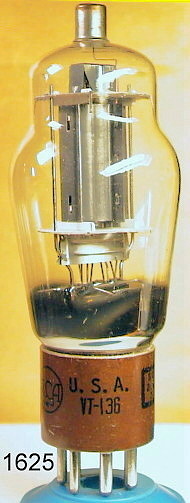
A new project: a 1625 single-ended amplifier
(picture from Google Images)
I've resisted the siren call of DIY audio for far too long. Since my busy mind is always in need of some new project, I've decided to once again tackle a SE amplifier. For this undertaking, I'll go for a budget build, using easy to get tubes with a vintage flavor. With a total price of under $600, Tte 1625 immediately sprung to mind - this is the 12V filament version of the famed 807, the precursor to the 6L6GC. Instead of Ultralinear or Triode, I've also decided to try out true Pentode operation.
I'm normally a triode or ultra-linear guy, but way back in my college days, I was walking along the sidewalk in the nasty neighborhood I was living in at the time. Ahead I saw a Magnavox stereo console out on the curb. A peek at the back and I saw tubes. With a little determination out came a little 6BQ5 amplifier with a pair of tiny open-frame output transformers. A SE amplifier! I brought this little unit back home, installed some RCA jacks, and soon had the amplifier up and running. The sound, for only 5Ws of power, was amazing. Sure, the low bass wasn't there, but there was a rightness to the music - especially the critical midrange. Not bad for a hunk of roadside trash. I ended up selling the Maganvox unit off to a friend where it was dubbed the "5W wonder". Yes, at the time I got better results with 2A3s and 300Bs in single-ended mode, but they had the benefit of better iron and passive components. After all these years, I'm still curious to see how a pure pentode amplifier with good parts will sound.
Of course it will have my usual tricks and favorites: tube rectification with the vintage 5Z3, screen regulation using VR tubes, a pentode input tube - the 12J7GT, and DC on the filmanents. So far I'm leaning towards Edcor for the output transformer with Hammond and Triad power and choke iron. Other parts will be KOA resistors, Wima coupling caps, Nichicon electrolytics, and whatever else I can scare up from my depleted junk drawer.
The initial schematic is already done, but may not survive once I get the first prototype up and running. So stay tuned for further updates when I will make the parts list available, along with the Front Panel Express metal layout, and final schematic. I will also try to include a step-by-step construction guide, but I usually get a little carried away when building a new project!
Update: Amplifier built - schematic and results.
Friday, October 5, 2012
New Room, New Stereo Changes
Due to some future job changes, I've sold my current house and have moved into some temporary rental digs. It's still a house, but a little smaller than before. I have a listening room of sorts, but due to the smaller room, the UREI speakers are being put into storage. Instead I have a pair of vintage Spica TC-50s coming in the mail. Though these will lack the punch, bass, and pure "wow" factor of the big UREIs, this little monitor is still time-aligned and known for its imaging capabilities. Review coming soon.
The fear of moving a stereo from one location to the other is the chance of something being broken. I made the mistake of keeping the Denon DL-103R cartridge attached to the tonearm. A slight accident, even though the tonearm and removable base was moved separately, caused the cantilever to snap. It was due for a replacement anyways, but it still hurt. Since I've gone to smaller digs and less revealing speakers, I've opted to try the Denon DL-110 high-output moving-coil cartridge. Review coming soon.
And since the overall system is being compromised, I've also decided not to burn up my vintage Mullard XF2 EL34 tubes and will be running something a little more modern. I have a two quads of Shuguang EL34s which sound half-decent with the EICO HF-60s. These, and a pair of Hitachi 5AR4s, will be put into service until the listening room situation improves.
On another note, moving the UREI speakers up a flight of stairs required three relatively strong guys. Each speaker had to be strapped to a dolly and then wrestled up step by step. Having a low trailer was also useful since tipping them up on a high 4X4 pickup truck would damage many backs.
Tuesday, September 4, 2012
New Project: Acrosound Stereo 20 Monoblock
Stereo 20 monoblock? Say what now? Well, back in the early days of stereo, many audio nuts were still using mono systems or saving up their dollars to buy another amplifier. A single monoblock was often cheaper than a stereo amplifier, giving a budget route to building up a true two-channel system.
In this case, the Acrosound 20 is exactly one-half of the (slightly) more popular 20/20 amplifier. There was even a 20A model which has no power transformer but instead gets its B+ and filament voltages from the 20 Monoblock octal socket. Very strange indeed.
I bought this little unit on Ebay. It's a pretty funky, but pretty in that 1950s vintage audio way - a nice hammertone paint job with some bling gold transformers. The circuity, except for the input caps, is DC coupled using a 12AX7 and a pair of 6BQ5 transformers. The PCB is mounted on top, ala Dynaco style, but a small cage can be used to stop prying fingers from being electrocuted. Output taps are 4-8-16-32, which should work with any crazy combination of speakers, provided just 18Ws of power is needed.
Of course I will have to be patient to find another monoblock - or even the more obscure 20A - but this should be a nice little project to tide my audio nervosa over for a few weeks. No, I'm not expecting it to compete with the EICO HF-60s, but a pair of Acrosound 20 amplifiers would be a great basis for a second system.
Update: New PCB board installed.
Subscribe to:
Posts (Atom)