Sunday, February 1, 2026

Review: Sonic Frontiers SFS-50 power amplifier


Introduction: It has been a long time since I've wanted to change power amplifiers. The latest iteration of the Franken-Eico ST70 - once completely modded and using some very nice vintage tubes - became my favorite vintage power amplifier ever.  It's only limitation, or so I thought, was the relatively small power output.  Not a big issue with my 88dB efficient KEF R5s in a mid-sized room.

However I have been considering getting a different pair of KEF speakers, the much newer (and improved) KEF R500 Metas.  These are 4-ohm speakers with only 86dB of efficiency.   This would be harder drive for the Eico amplifier.  With that in mind I started looking getting some more power.  Since I'm a vintage tube guy at heart, a pair of Dynaco Mark III was one of the first things that came to mind.  These can make a solid bit of power and have different driver and power supply boards available.  This would make the project a whole lot easier than hardwiring (like my Eico ST70 has).  

However prices have certainly gone up on vintage gear.  The days of getting a $150 Dynaco ST70, or a $500 pair of Mark III have long disappeared.  With the price of the amplifiers, new input and PS boards, tubes, I was looking at a total cost of a more modern amplifier.  A hunt through Audiogon and saw two possibilities. 

 The first was an Audio Research VS55 that would have been a great visual match for my (much older!) SP-8 preamplifier.  However the use of 6N1Ps - and no mention of being able to use 6DJ8s - made me reconsider.  Also looking at the schematic showed a rather low B+ along with no regulation for the (pentode output) screens.  Within a few days it was sold, leaving the next amplifier on my list as the only affordable choice.

The Sonic Frontiers SFS-50 is an early 1990s design with a Joe Curcio circuit design.  The input/driver is a cascode differential with a current sink on the cathodes and power supply regulation.  This circuit provides very accurate phase splitting and wide bandwidth even before loop feedback is applied.  The output circuit is pure pentode in push pull class A with regulated screens, allowing the use of the 6550 or EL34.  The visual look, at least to my eyes, looks upscale with a touch of Heath W-6 mixed with classic Jadis.  The output transformers are also enormous, usually meaning a good bass response. The interior circuit photo shows some nice parts quality - like Holco resistors, WonderCap and RelCap coupling capacitors, Solen power supply bypass caps, and shielded cabling for both the input and feedback. There is a lot here to like and follow some of my more recent DIY experiments.


Upon receiving the amplifier I found myself with one heavy box.  Removed from the packing the Sonic Frontiers amp is also much bigger than I expected, taking some muscle to slide it into place next to my right speaker.  The tubes that came with the unit aren't exactly high on my list - Chinese 6N11 and the Sovtek 6550s.  The cold sound that came out of the speakers was indicative of both the  winter temperatures here in Michigan and the "solid state in a bottle" effect of less-than exemplar tubes.  An hour of listening led to one heck of a headache.

I had some older Shuguang 6550s and a pair of tested & section matched 1970s Amperex 6DJ8s on hand.  That really improved the sound, but there was still an unpleasant forward nature.  I could hear some great imaging but I was not satisfied with the overall sound.  The idea of putting the Eico ST70 back into the system was starting to become a real possibility.


Luckily I have an old friend with a deep knowledge of tubes.  After a phone conversation he came over the next day with a box of different makes of 6DJ8s.  From the get go - and the nature of the differential input circuit, we decided on using a quad of 1970s Mullard 7308s - the tested and spec'd military version of the 6DJ8. Even with the system just starting to warm up, we decided to start with some well-known records from my collection.


Listening: 


Casino Royale is a 1967 soundtrack for a James Bond spoof.  The well-known track, at least to audiophiles of yore, is the The Look of Love sung by Dusty Springfield.  It's extremely well recorded with a clean and wide soundstage.  The sensual vocals and saxophone solo really stand out with plenty of detail with natural decay.


I'm lucky to have 1993 pressing of Dead Can Dance's Into the Labyrinth.  The song The Ubiquitous Mr. Lovegrove is a favorite of mine - for the sonics and the music.  It's a track I've used for several reviews so I know it well.  With the SFS-50 the bass had tremendous extension and depth.  The sound of the fingers on the drums had more detail than the Eico too.  Also the left and right soundstaging width was mesmerizing.  A truly audiophile experience in all the right ways.


This album sound quality improves with every upgrade.  The second song of Lonnie Liston Smith's Visions of a New World is titled Love Beams.  The mix is dense with a lot of small percussive sounds.  With the SFS-50, the vocals sounded deeper than ever.  The small bells rang and shimmered, standing apart from the rest of the instruments.  


The Who's Tommy double LP has several different pressings of varying quality.  My favorite - at least available at a sane price! - is the German Tracks version.  This album is not exactly well-recorded but has moments that shine through - like the hard dynamic guitar playing of Pete Townshend and, of course, the drumming of Keith Moon.  With the Sonic Frontiers I heard touches of more detail and a deeper soundstage than I remember before.


Conclusion:   Much to my surprise the Sonic Frontiers turned out to be extremely neutral and could separate instruments better than any amplifier that I've owned.  The bass was phenomenal, both deep and precise, lacking tube bloat or smear.  The treble - at lease with the Mullard 7308s - was not etched, just natural and extended with plenty of air and detail.  The forwardness, which I thought was part of the character of the amplifier, was also gone.

Detail retrieval was phenomenal - I was hearing little bits of information that I had never heard before, making my Rega P8 sound even better than I thought.  Soundstaging was deep and wide, vocals and instruments far back (if mixed so), giving an effect that added real breath and realism to the music.

This is not a "tubey" amplifier by any stretch, nor does it sound like solid-state either.  Very fast but no etched upper mids, or tizzy treble.  My friend and I were both actually blown away how good this sounds, especially considering the price.  This is no expensive Audio Research D-250 or EAR 509s but still the Sonic Frontiers delivers extremely high fidelity, more so than any amplifier I have ever owned.

 Next up is an output tube upgrade.  Stay tuned!


System:

Rega P8 turntable with Rega Ania Pro MC cartridge 

to a Denon AU-S1 step-up transformer

to Cardas Neutral Reference interconnects

to an Audio Research SP-8 (with a mix of vintage Mullurd and Amperex tubes)

to Cardas Iridium interconnects

to the Sonic Frontiers SFS-50 amplifier

to Cardas Iridium speaker cables

to KEF R500 loudspeakers 


Thursday, October 10, 2024

Review: Denon AU-S1 step up transformer


Moving back to a low output moving coil has been a real eye-opener.  Yes I had experience with the venerable Denon DL-103R mounted on a rather sketchy VPI HW19 Mark III with a Rega RB300.  But, at least with that system from long ago, I never quite cottoned to the sound I was getting.  I wanted more.  Luckily I found it (some time later!) with the Rega Planar 8 with a Rega Ania Pro MC cartridge.  This combination has quickly become my favorite analog reproducer so far.

My MC step-up transformer is the popular Cinemag 1254 which did its job quite admirably.  Nonetheless I had a nagging thought I could do better here.  Would a passive device, especially something made of wound wire actually make a difference?  I had to find out.  So I read and read some more, trying to find an affordable venue to follow.  I thought of buying some Lundahl transformers and DIYing my own case.  Or I could have gotten anything else, including an active device to give me that additional gain needed for the low 350 micro volt output of the Ania Pro.

Several searches on Ebay and I saw a Denon AU-S1 unit for sale.  It looked extremely well built, more so than my Cinemag "transformers on a box" look.  But finding information on the Denon was, to be blunt, extremely difficult.  It was designed for Denon's once top-of-the-line cartridge, the DL-S1 that cost a princely $1000 way back in 1996.  The transformers themselves are mounted horizontally in the case with padding to reduce vibration.  How much this would work in real life is questionable.

After several audio philosophical discussions a friend, I decided to take the risk on purchasing the AU-S1.  It was the idea that something like this would be of the highest quality given the amount of time and research that a company like Denon can do.  There was only way to find out.  Thankfully the Japanese seller was very quick and I received the transformer(s) in only three days.  The AU-S1 weighs _alot_ for such a small thing.  Build quality was extremely good with gold-plated RCA jacks and (oddly enough) separate grounding lugs for each channel.

 I took out the Cinemags and put the Denon in its place.  Turning the volume up I was immediately taken aback by the amount of hum I was getting out of the speakers.  Moving the AU-S1 around and I was able to get some reduction in noise but still I wasn't happy about it.  It wasn't until I touched my fingers to the left RCA outside jack and then to the ground lug that the hum completely disappeared.  It's the nature of the Rega turntable output connection which doesnt have a separate ground wire.   To circumvent this grounding issue I took a length of solid-core bare wire and wrapped it several times around the left RCA outside lug with one end plugged into the ground lug of the AU-S1.  After that I was hum free!

Well, dear readers, that was a lot of introduction for something that was ultimately bought as an experiment.  How does it sound?  Read on.

Initial impressions were good - solid bass, a "cleaner" view of the soundstage, and just better air. Several records later and a listening session with my audiophile friend and I can say the Denon AU-S1 was a worthwhile upgrade.   

Does it surpass the Cinemags?  Yes.

The Denon reproduces the space around instruments better - such as the horns on Lonnie Liston Smith's Visions of a New World.  This gives the impression of more body and weight.  

And speaking of body, the bass is terrific.  It feels like an extra octave is being recovered - not bloated - but detailed with depth and slap.  Something that was really apparent on Brian Bennet's Voyage album as the excellent bass player provides the space age groove.

Soundstaging is deeper and wider than before.  An example of this is the beautiful Dead Can Dance album Into the Labyrinth.  The second song, "The Ubiquitous Mr Lovegrove," has a moment where the drum shifts left and right, now well detailed beyond the edges of my KEF speakers.  A true demo disc moment.

Overall there seems to be less grain than before.  Why?  I have no idea.  The purity of the copper?  The padding reducing microphonics?  The quality of the transformer windings?  Your guess is as good as mine but the clarity is higher than before and that's all that matters.  Finesse would be a fine word to discuss these SUTs, and given their roughly $700USD price they are a good bang for the buck.  Perhaps, when funds permit, I'll try something more expensive.


Denon AU-S1 Step-up Transformer Specifications
- Ratio: 1:13
- Frequency range: 10Hz-80kHz
- Size: W150 x H70 x D175mm
- Weight: 7.1 pounds

Tuesday, August 8, 2023

Review: Sovtek 12AX7WA

 I have a love and hate relationship with Russian tubes.  Some of them - like the ECC99 - rival some of the best vintage American and European tubes, while others, like much of the Electro-Harmonix line sounds like solid-state in a bottle.  Yes these tubes can be transparent but they are often lacking in detail or suffer from an aggressive treble and upper midrange.

The early Russian tubes, that first were available in the 1990s to the Western World, were godsend to the tube-o-phile community.  They were cheap and rugged.  An example of this is the 5881WXT which could take the current hungry bias of the Harmon-Kardon Citation V.  Even a RCA blackplate of the era would start to glow on the seams.  But not these Russian mil-spec tubes.

It's been my belief - shared by some friends too - that Russian tubes have good metallurgy but not the best cathode chemistry.  Yes they are rugged, but many of them have the already mentioned issues with the higher frequencies.

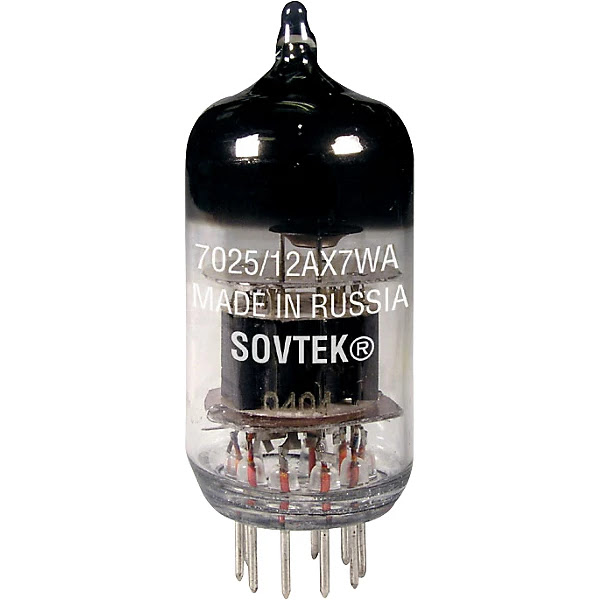
As for the Sovtek 12AX7WA, it has a pair of very small coated plates and what I would call a primitive looking spacer that should be made out of mica.  The pins ends are sharp but overall construction looks quite good.  I plugged it into my Frankenstein EICO ST70, which provides the initial gain before the 6SN7 phase-splitter.

The Sound:  Initially I was surprised how much I like the Sovtek.  The sound was very transparent and, at first listen, very modern sounding.  I was reminded of a really good JFET preamplifier or MOSFET amplifier - big, dynamic and smooth.  But, like the aforementioned solid-state gear, lacking in inner detail.  The soundstage was also smeared a bit, removing the space around individual instruments and the big front-to-back sound of a vintage Mullard.  Dynamics in the upper part of the spectrum became a little rough/forced sounding with the Sovtek.

What I'm really finding - at least so far - is that modern tubes often has a good tonal presentation but lack in inner detail and making a big soundstage.  I'm curious to the reason why this is true.  Is this linearity or an artificial presentation brought on by - an unknown variable?  We shall have to continue and have some vintage comparisons.  More later!

Review: Rega Planar 8 turntable


I've owned a half-dozen turntables in my time.  Starting with an old Technics direct driver with a p-mount cartridge and working through two VPIs, a long running Dual CS5000, and two Thorens of varying vintages.  Except for some experimentation with the Denon DL-103R MC, it has mostly been MM cartridges of different expenses.  I thought, for example that the Thorens TD309 and Ortofon Bronze cartridge was very good - especially for the price - combination.

Well the past few months living with a new Rega RP8 and Ania Pro MC cartridge has been a real eye-opener.  Gone is the fuzziness and opaqueness of the MM sound, replaced by more detail and a bigger soundstage.  The experience has changed my mind about the moving magnet.  Though the Rega Ania Pro MC needs a step-up transformer  - in my case Cinemag 1254s - the speed and transparency has brought everything up to a much higher level of refinement.

Since there are already several reviews of the 'table I will keep it short.

The biggest surprise with the Rega combination is the bass and dynamics.  It was always my belief that a "real" turntable required a gagillion pound platter and base.  Instead the RP8 is decidedly unimpressive - at least visually - compared to something like a VPI Aries.  How did Rega do it?  I have no idea about the mechanical engineering behind this table, but, to my ears, is just works.  Perhaps it is the turntable acting as a whole system with a cartridge, arm, and everything else like the included speed controller working together.

Soundstaging, like on several original Dead Can Dance LPs, is superlative.  We are talking a rounded arc left-to-right that goes beyond the edges of the speaker, along with exceptional depth.  The coloration and clarity of something like Lonnie Liston Smith's Visions of a New World comes through much better than my now-departed Thorens TD309/Ortofon 2M Bronze.  This is also a big sound turntable with excellent resolution and separation of instruments; exceeding any front end I've ever had before.

Yes the Rega RP8 is much more expensive than my previous turntable but, at least in this case, the cost was worth the sonic upgrade.  Not only does my whole system sound that much better, but everything from the preamp to the amplifier and even the speakers sound way better than their price point. 

Very, very recommended.

System:

  • Audio Research SP8
  • modified Eico ST70 with 6AR6 tubes
  • Cardas Neutral Reference interconnects
  • KEF R500 speakers with Mogami stranded wiring
  • Dual CS5000 turntable with an Ortofon OM20 cart, aftermarket Shibata Stylus

Thursday, September 29, 2022

Review: JJ ECC83S short plate 12AX7


To be honest my expectations for this 12AX7 was low.  I haven't had a JJ tube in any of my gear for well over a decade.  Nothing personal, mind you, but back then I was all about more exotic tubes like the C3m, 5687s, EL156s, and whatnot.  JJ has been around since 1994, built on the ashes of Tesla and Ei.  Their small signal tubes aren't mentioned all that much on the forums I visit, or at least I missed the posts.

This particular version of the 12AX7 looks to be based on the famed Telefunken ECC803S, which also had a Tesla copy.  The architecture has small plates that are very similar to a 6DJ8.  This should translate to low microphonics.

As for the sound, at least as the gain tube for a power amplifier, the JJ ECC83S was better than I expected.  There is an overall darkness, making this a good match for some zingier MC cartridges or digital front ends.  This is a "chocolate" expression of the music, with solid and tuneful bass, warm mids, and a high end (to my older ears) that is even less detailed than a Mullard. 

Inner detail with the JJ is less than the long plate Mullard; a slight smearing of instrument and vocal space along with soundstage depth.  Nonetheless at least the JJ sounds like an vacuum tube unlike some of the inexpensive Russian offerings I've heard.  So, much like the TJ and the Psvane, a solid offering but, and your mileage will vary, not exceeding the better old stock versions of the 12AX7 I've heard.