Showing posts with label mullard. Show all posts

Tuesday, August 8, 2023

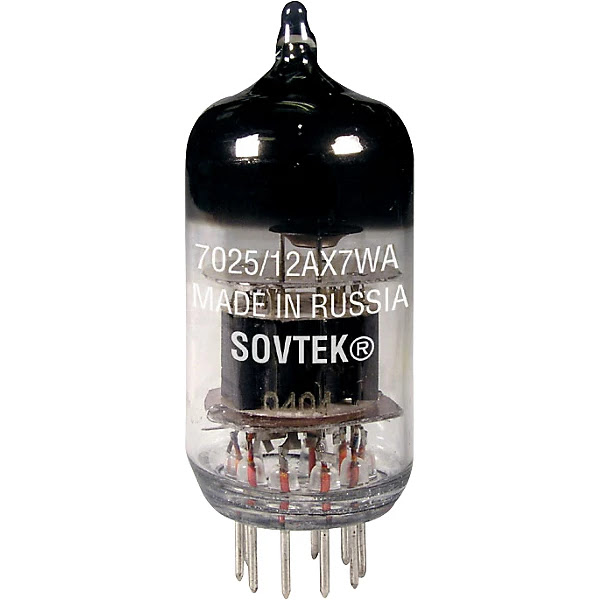
Review: Sovtek 12AX7WA

 I have a love and hate relationship with Russian tubes.  Some of them - like the ECC99 - rival some of the best vintage American and European tubes, while others, like much of the Electro-Harmonix line sounds like solid-state in a bottle.  Yes these tubes can be transparent but they are often lacking in detail or suffer from an aggressive treble and upper midrange.

The early Russian tubes, that first were available in the 1990s to the Western World, were godsend to the tube-o-phile community.  They were cheap and rugged.  An example of this is the 5881WXT which could take the current hungry bias of the Harmon-Kardon Citation V.  Even a RCA blackplate of the era would start to glow on the seams.  But not these Russian mil-spec tubes.

It's been my belief - shared by some friends too - that Russian tubes have good metallurgy but not the best cathode chemistry.  Yes they are rugged, but many of them have the already mentioned issues with the higher frequencies.

As for the Sovtek 12AX7WA, it has a pair of very small coated plates and what I would call a primitive looking spacer that should be made out of mica.  The pins ends are sharp but overall construction looks quite good.  I plugged it into my Frankenstein EICO ST70, which provides the initial gain before the 6SN7 phase-splitter.

The Sound:  Initially I was surprised how much I like the Sovtek.  The sound was very transparent and, at first listen, very modern sounding.  I was reminded of a really good JFET preamplifier or MOSFET amplifier - big, dynamic and smooth.  But, like the aforementioned solid-state gear, lacking in inner detail.  The soundstage was also smeared a bit, removing the space around individual instruments and the big front-to-back sound of a vintage Mullard.  Dynamics in the upper part of the spectrum became a little rough/forced sounding with the Sovtek.

What I'm really finding - at least so far - is that modern tubes often has a good tonal presentation but lack in inner detail and making a big soundstage.  I'm curious to the reason why this is true.  Is this linearity or an artificial presentation brought on by - an unknown variable?  We shall have to continue and have some vintage comparisons.  More later!

Thursday, September 29, 2022

Review: JJ ECC83S short plate 12AX7


To be honest my expectations for this 12AX7 was low.  I haven't had a JJ tube in any of my gear for well over a decade.  Nothing personal, mind you, but back then I was all about more exotic tubes like the C3m, 5687s, EL156s, and whatnot.  JJ has been around since 1994, built on the ashes of Tesla and Ei.  Their small signal tubes aren't mentioned all that much on the forums I visit, or at least I missed the posts.

This particular version of the 12AX7 looks to be based on the famed Telefunken ECC803S, which also had a Tesla copy.  The architecture has small plates that are very similar to a 6DJ8.  This should translate to low microphonics.

As for the sound, at least as the gain tube for a power amplifier, the JJ ECC83S was better than I expected.  There is an overall darkness, making this a good match for some zingier MC cartridges or digital front ends.  This is a "chocolate" expression of the music, with solid and tuneful bass, warm mids, and a high end (to my older ears) that is even less detailed than a Mullard. 

Inner detail with the JJ is less than the long plate Mullard; a slight smearing of instrument and vocal space along with soundstage depth.  Nonetheless at least the JJ sounds like an vacuum tube unlike some of the inexpensive Russian offerings I've heard.  So, much like the TJ and the Psvane, a solid offering but, and your mileage will vary, not exceeding the better old stock versions of the 12AX7 I've heard.

Monday, September 19, 2022

Review: Psvane 12AX7


The Psvane T-12AX7, apparently the base version, is a Chinese design that looks much like a vintage one with gray ribbed plates, quality construction, and steel pins.  The triple-layed mica also looks good.  Bulb size, like so many other new tubes, is slightly larger than my collection of old stock, a mm or two difference in height and circumference..

Break-in was approximately fifty hours as the driver tube in my Frankenstein Eico ST70.  This is basically the classic Mullard 5-20 circuit.  It's been my general experience that the driver tube - before the phase splitter - has a high impact on the overall amplifier sound, more so than the phase-splitter or even the output tubes.

Listening was initially done while reading a book.  There were several times where I had to look up from the pages to truly appreciate what I was hearing.  Like the TJ FullMusic, the Psvane has a great almost vintage tone.  I was hearing little details - an example is Lonnie Liston Smith's Vision of a New World - that I thought weren't apparent to my standard vintage Mullard.  I was beginning to feel some really high hopes for this Psvane.

However some further, more detailed listening, some of it shared with an old audiophile friend with an extensive knowledge of 12AX7s both new and old, began to show some weaknesses.  Though the sound was never muffled, the Psvane, like the TJ, also lacked inner detail and bloom around the instruments.  But wait a minute, you say, where did that extra detail you mentioned go?  It is a strange effect of the Psvane: suppression of reverberation both artificial or natural, pushed some information forward.

Keep in mind this is still the best new production 12AX7 I've heard and I could see use for it in gear or speakers that aren't the most transparent.  The bass was excellent, there was a distinct lack of glare unlike some lesser "solid-state in a bottle" new production tubes.  The midrange was also even as was the treble.  It was just the lack of detail that stopped the Pvane running with the best of the vintage 12AX7s.

Disclaimers: No tube is 100% perfect for all gear.  The only way to be sure how a tube will sound in _your_ system is to hear it.  Also a tube in a phono stage, for example, may have different audio characteristics than say line, input, or phase-splitter use.

 Negative feedback - several dB in this circuit - also reduces the sonic signature of the tube.  An example of this came apparent to me when I built a triode-connected EF86 linestage.  The tube selection - GEC CV4085 and the Mullard "long mesh" were the best - played a big role in the sound quality.  However the EF86 in my Eico HF60 monoblocks were less important, most likely due to the loop negative feedback or perhaps the total number of tubes in play with a more complicated circuit.

 It should also be noted that I am not biased towards vintage tubes.  I really do want a new tube that can compete with the old.

So take this review as a general guideline, not as hard fact.

Monday, February 24, 2014

Tube Review: The Mullard XF2 EL34 pentode

Introduction:
The Mullard EL34 - though perhaps not the best sounding of this family of tubes - is famous for a big and rich sound favored by guitarists and hi-fi nuts.  The XF2 version, like many early tubes, has welded plates, along with that thick, dark getter that is a trademark of the valves that rolled out from the Blackburn factory.  Later ones have similar construction but used crimped plates - I've never sat down and compared the different XF models, but needless to say they're all pretty good.

 The Mullard "sound", for whatever reason, has always been on the darker scale than neutrality.  Perhaps there is some secret mojo in the cathode chemistry or the metal quality, but this sound difference is easily noticeable in comparison to an original Philips EL34 or even any modern EL34.  This romantic sound, in the wrong amplifier, can lead to a syrupy sound - I'm thinking of something like a stock Dynaco 70 or any vintage amplifier with weak power supply capacitors and/or oil coupling capacitors.  So, like anything else, system balance is important.

The pair of Mullard XF2 EL34s I'm reviewing here are high mileage units pulled from my Eico HF-60 monoblocks.  Though they have plenty of hours on them, they still test almost as new - longevity is something that vintage tubes seem to do well and is needed, especially when running in something as abusive as the HF-60.  For this amplifier with a plate voltage of 400VDC and a screen of 250VDC, 60mA was chosen as a nice cruising speed.

Listening Tests:
The Immortal Otis Redding has a nice and punchy sound, albeit a tad stripped down.  The Mullards conveyed this simple recording with excellent clarity, depth, and dynamics.  Otis's voice sounded very natural as did the instrumentation.  The sound never became harsh or strident with this output tube.  There was also a nice projection to the vocals, pushing the sound beyond the speakers.  This seems to be a trait of vintage tubes - an enveloping sound with a 3-D effect: layered depth, wide and stable imaging, and a sense of being tangibly involved in the music.

Frank Sinatra - Sinatra at the Sands appears to be a three channel recording with instrumentation on the left and right with Frank right in the middle of the action.  The dynamics - on the right system - are truly breathtaking.  The Mullard EL34 excelled here, sounding almost as big as the Tung Sol 6550.  On the quieter songs like Don't Worry 'bout Me, all the emotion came through with the sensitivity that only Sinatra could surprisingly pull from that playboy act.

The last record in this listening test was Steely Dan - Aja which is a modern recording with deep bass, shifting dynamics, and crafty compositions.  The Mullard EL34 wonderfully captured the trailing edges of the reverberation and gave a soundstage that was big and organic.  The instruments floated nicely in space too.  There was a touch of darkness to the music, giving a not quite neutral sound compared to a Tung Sol 6550 or the ultra-vividness of the Philips metal base.

Conclusion:
The Mullard EL34, compared to the new production tubes I've heard, has a real magic.  The music flows with more ease - a naturalness that is hard to describe, but the sound that is reproduced is cut from the same cloth in a grain-free way that makes me forget that I'm listening to a stereo.  Even the Shuguang GEKT88 - which is very good - doesn't capture this ability of convey the real soul of the recording.

However, the Mullard is not the most hyper-detailed and bends the signal to a darker, more romantic spectrum.  But this is a nice place to be - especially in the world of hot digital recordings and aggressive moving-coils.  If you're searching for the most transparent or an abundance of detail, then this may not be the tube for you.  But - and this varies from listener to listener - any sins are easy to forgive.  This is a tube for the music lover, not the nitpicker. 

Monday, January 14, 2013

Tube Review: Genalex - Gold Lion B759 / 12AX7A

(Image from Google)

I'll admit right off the bat that I've never been a huge fan of small signal Russian tubes.  Overall they seem to have a "solid-state in a bottle" effect and certainly don't come close to some of the better NOS offerings from Mullard, Amperex, RCA, and company.  I would even prefer to spend my money on GE, Ei, Raytheons, or CBS tubes.

The other night I was given a chance to borrow a pair of re-issue Genalex B759 / 12AX7A tubes.  The boxes are certainly a nice copy of the original, as is the logo imprinted on the glass.  However, if you compare the "re-issue" to the original, they are in fact nothing alike.  Of course the machinery that made the original British tube is long gone.  It's a small point, but I never liked the use of the term "re-issue" which means, at least to me, that the product actually has some connection to the past.

Instead, the Genalex B759 looks like a Sovtek 12AX7LPS - the plate, mica, and layout are the same.  Perhaps there is some magic going on with the screens and cathode chemistry, but that's difficult to tell without breaking them and taking a look inside while doing a chemical analysis.  So one theory - these could be just highly selected and matched "super" Sovtek tubes.  Perhaps a softer vacuum could come into play.

Okay, enough intellectual yammering.  How does the tube sound?

My Quicksilver full-function uses a 12AX7 as the first tube in the phono section.  The linestage also has one.  I pulled out my 1960s short-plate Mullards and replaced them with the Genalex B759.  I had a fellow audiophile over to listen.  As we talk tubes and single-ended amps, we let the whole system warm up for a while before listening.  Hmm... this actually sounds better than I expected.  Yes, the Genalex tubes do sound different than the Mullards, but within the confines of this system, the B759s are completely acceptable.

The first word that comes to mind is fast - perhaps due to a bit of additional upper-midrange/lower-treble excitement.  This extra bit of zing makes music fun and engaging, all without sounding overly bright or with the type of "solid-state" grain I normally associate with many small signal Russian tubes.  Overall depth seemed a tad flatter than the Mullards, but the effect lessened the longer the preamplifier was on.  Coherency from the lowest to the highest octave was even handed, except for the already noted touch of forwardness.  "I could live with these" was one comment I made as Fleetwood Mac was spinning away.

So yes, the Genalex B759 / 12AX7A does deliver the goods, though I fear a more revealing speaker - like the UREI 813As - would show more limitations.  I suspect this tube may not be a good match for forward systems - especially ones using horn loudspeakers.  However, they would be a great match for some darker sounding gear like the Dynaco PAS or Eico HF-85 preamplifiers.  With the ever rising cost and increasing scarcity of decent NOS tubes, it is good to know that there are real alternatives out there.


Thursday, June 14, 2012

Review: Quicksilver full function preamplifier


Introduction
Quicksilver has been around for quite some time, but their products are often overlooked for the more flashy Conrad-Johnson, Audio Research, or whatnot.  However, much like VTL, Quicksilver instead concentrates on simple but solid tube circuitry, robust old-school construction, and moderate - at least for audiophile gear - prices.  The full function preamplifier in question is the earliest incarnation of the product having first hit the street in 1988.  Price back then was a princely $1995, making it roughly in the same price range as the famed Audio Research SP-8 or the slightly later Conrad-Johnson PV11.

I bought mine from a seller on Audiogon.  Shipping was prompt and I received a very heavy duty preamplifier that doesn't quite have the same ooze of quality that ARC or McIntosh has, but certainly is no slouch in fit 'n' finish.  Cracking open the top plate grills, you will see that the power supply and signal path are separated by a thick steel wall.  Very nice.  Component quality is also good though hardly esoteric.


Circuit and Controls
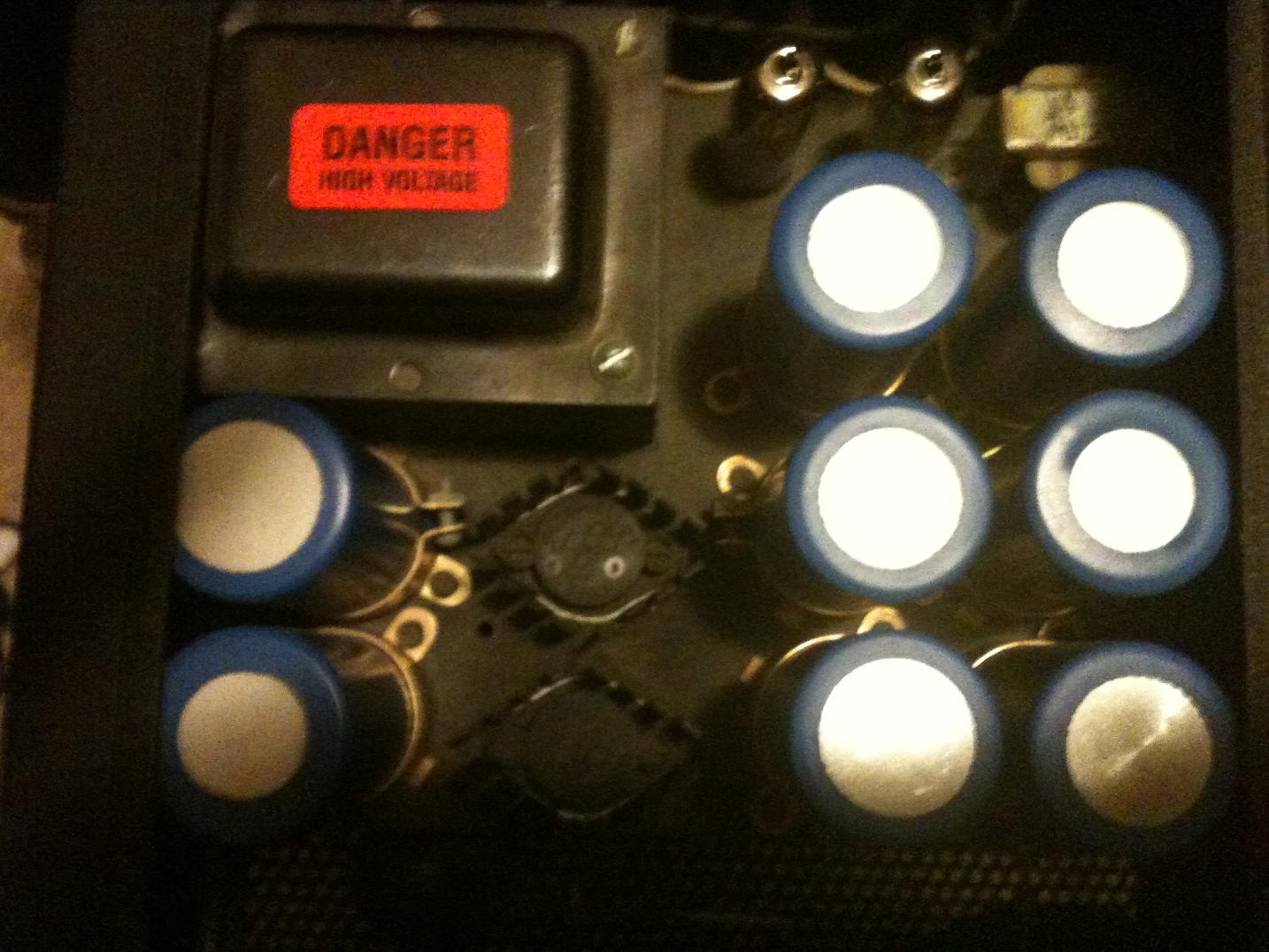
A quick look over the tube complement and circuitry:  Some of this is based on guesswork since no schematic could be found.  The power supply uses a large power transformer, a pair of 6X4s which are still widely available NOS, a small choke and a number of large Mallory capacitors to provide the DC smoothing, along with some regulation for what I assume are the tube filaments.  The line stage uses one 12AX7, one 12AU7, and one 12FQ7.  Since the reported output impedance is so low, I'm assuming the 12FQ7 is being used as a cathode-follower with some negative feedback wrapped around the entire circuit.  The last bit is the phono stage which only uses a single 12AX7 and a 12FQ7 with some sort of green LED biasing.  Coupling capacitor quality is in the meh range, but hardly out of place for the era.  The big 2uF capacitors on the output stage are some REL Polyesters (ughh).  The smaller signal caps are branded Quicksilver though also look to be REL made.

Front controls are fairly standard though a little dated: No remote here!  Lighted power, AC rear receptacle switch, and a mute button make up the left hand of the faceplate.  The right side has a tape monitor switches, a reduced (20dB) gain switch, a selector switch, and a stereo/mono/etc switch.  Volume control is dual mono with one stepped Blue Alps per channel.  These actually work better than expected - with the numbered volume steps it's very easy to match levels between channels.

Rear panel is the usual assortment of nice gold-plated RCA jacks and a grounding post for the phono stage.  Power cord is captive.  Fuse Holder holds a 1A unit.  AC receptacles are a nice throwback to the days when the user would power up his amp and sources with one flick of the on button.


The Sound
Okay, enough introductions - how does it sound?  Well, since this is an older unit, the stock tubes are long gone.  For the purposes of this review I used some really nice NOS tubes from my stash, so results will vary to a certain degree depending on what is plugged into the sockets.  In my case I used early 1960s short plate Mullard 12AX7s, a late 1940s black-plate RCA 12AU7, and 1960s-era side-getter RCA 12FQ7s.  Rectifier tubes were Tungsol 6X4s.  Some generic tube damping rings came with the unit, so I kept those in place.

It's been my experience that ultra-regulated, current-sourced, current-sinked, and whatnot circuits are very detailed, but also suffer from sounding slightly unnatural.  Note that tube regulators are usually better than solid-state, while shunt suffers from less sterile sound than series.  My own DIY experiments with a simple linestage showed that pulling regulation out of the circuit actually improved overall musicality and enjoyment.  Sure, some of the last bits of inner-detail are missing, but the music usually sounds more relaxed with a looser power supply.  This type of sound was very evident with the Quicksilver preamplifier which just uses chokes and caps to provide a clean source of DC.

Compared to my old Threshold FET-10/HL linestage and Audio Sector Phono Stage, the Quicksilver (with Cinemag step-up transformers) has a relaxed presentation that draws you into the deep soundstage.  It's almost like unclenching your teeth after a roller-coaster ride, or taking a good solid gulp of your favorite adult beverage: the muscles relax and you sit back with enjoyment, washed away by the sonic swirl of the music.  A good stereo should be a psychedelic experience - an unregulated and legal high - that lets you forget the troubles of the world.  With the Quicksilver preamplifier, I feel as if my entire audio experience has been improved.


Listening Notes:
I used my turntable exclusively for this review, but the linstage by itself is no slouch either.  The Audio Sector phono stage combined with the Quicksilver was a pleasant surprise, but the Cinemag and native phono section got the nod in sound quality.

The Who - Tommy (W. German Polydor):  The Quicksilver has very excellent detail and speed, keeping up with Keith Moon's manic drumming without breaking a sweat.  Small individual instruments - like a small bell - maintained their place in the soundstage while still being audible in the wash of thundering bass and guitars.  Depth was deeeeep, making my room seem bigger than reality.

The Beatles - Rubber Soul (Japanese Parlophone): This particular cut of this famed album has been described as bright and bass heavy compared to the original British pressings, but to my ears it sounds like it was eq'd flat.  With the Quicksilver, treble is extended and detailed with out any forwardness or grit.  There is lots of nice detail with John's wonderful voice cutting through the primitive stereo mix.  It's harder to get closer to the Beatles than this.

Tom Waits - Closing Time (80s Asylum): Perhaps I'm a sentimental slob, but I love this album.  However, the Quicksilver revealed the limitations of this later pressing.  Some detail, compared to some better versions, was missing, as if the music was hiding behind a thin gauze.  Tom Waits voice, however, was still wonderful, leading to some near tears while listening to the bittersweet song Martha.

Record after record revealed a preamplifier - and stereo system - that was very analog sounding.  Perhaps somewhat lacking in some of the hyperdetailed / transparency of more modern pieces, the Quicksilver was still no slouch.  When it came to musical enjoyment, I give it an extremely high ranking since it never sounds bleached out or unnatural, even with less-than-perfect recorded music.  If you want a preamplifier that speaks to the mind instead of the heart, you may want to look elsewhere.  I've gone down that road with my foray into solid-state gear, but I'll take naturalness over artificial effects any day of the week.


Overall:
Soundstaging:  Deep and Wide, imaging goes beyond the boundaries of the speakers and even the walls of my listening room.

Treble: Airy and extended, but also pure and detailed.  Compared to the darker Threshold/Audio Sector, it seems there is even more overall treble, but yet it never is harsh or unfaithful to the record.  A strange effect and not at all what I expected from tubes and a step-up transformer.

Midrange: Glorious, but not overly slow or "tubey" in the classic sense.  The Quicksilver certainly doesn't sound like a soggy Dynaco PAS.

Bass: The 12FQ7 output tubes can swing some current while delivering a low output impedance.  This translated into control.  I certainly didn't miss the solid-state drive of my last preamplifier combination.

Speed: (or PRAT) Good tube gear isn't supposed to be sloggy 'n' slow.  The Quicksilver preamplifier and Yaqin amplifier combination certainly doesn't sound like an aged tube integrated or a Dynaco 70 in need of a rebuild.  Instead, the music transients started and stopped on a dime with no overhang.  With the UREI loudspeakers, this led to a very dynamic, exciting, but yet unfatiguing sound.

Detail: As mentioned above, the Quicksilver is no king at wringing out the very last drop of detail from the music.  No, it isn't flat or uninvolving, but the very last bits of information are perhaps less apparent than some other units I've heard.  Some of this may be due to the large Polyster output capacitors.  An upgrade is due for some of the parts - notably some new polypropolene capacitors - so it will be interesting to see what effect this has on the sound.  But really, I'm not complaining because I'll take all of the positive attributes over hearing the squeaky chair of the violinist in the third row.of the orchestra pit.


Conclusion
For a going used price of $850-$1000, the Quicksilver full function preamplifier is highly recommended.  It's extremely well-made and is very natural sounding.  Errors - and I mean minor - are ones of omission with a high scale of musicality.  The simple circuitry will minimize future troubles since there are less "moving parts" once you get rid of the solid-state and regulation support circuitry often found in modern tube preamplifiers.  I expect to increase the audio grade of this unit with some coupling and electrolytic capacitor replacement, so stay tuned!


Main System:
VPI HW19 Mark III with SDS Power Supply
aluminum rebodied Denon DL-103R
Rega RB300 with Cardas wiring
Cinemag CMQEE-3440A in custom aluminum box
Cardas Cross 1M interconnects
Quicksilver preamplifier with (real) Mullard 12AX7s, RCA 12FQ7s, and a RCA 12AU7
Cardas Quadlink 5C 1M interconnects
Yaqin MC-10T amplifier with black-plate RCA 12AT7s and (real) Mullard XF2 EL34s
Cardas Hexlink 2M speaker cables
UREI 813A speakers
VTI BL503 equipment rack