Showing posts with label how. Show all posts

Thursday, September 24, 2026

Review: VTL Stereo Deluxe 90/90 power amplifier


A year or two into my audio journey, I was in college when an friend replaced his heavily modified McIntosh 240 amplifier with a set of VTL Compact 100 Monoblocks.  Our little audio community were a little disappointed since this change also meant the removal of his Quad ESL-63s.  These electrostatics were replaced by a big ol' pair of UREI 813 dynamic speakers, using the Alnico version of the Altec 604.  But, to be fair, the Quads - without a subwoofer, weren't the best for rocking out.  Understandable to us 20-somethings.

Along with the amplifiers came the VTL book, something that he loaned to me.  At the time I didn't know too much about circuits so I read David Manley's words with much interest.  I was a poor college student at the time and was firmly stuck in the (then) more affordable world of vintage gear.  Dynaco was more my speed with the PAS-3X and the Mark IVs being in my system at the time.  Owning new tube gear was just out of my means.  

I'll hit the fast forward button on my life.  So many years later my interest in modifying or building my own tube or solid-state gear has declined.  Some of it is cost, why make a tube amp when there are so many reasonably priced units out there?  And a lot of it is patience and my close up vision isn't what it used to be.  The idea of staring at a circuit board or a snake pit of wires hour after hour no longer holds the same interest.  It is so much easier to buy something, and at such a reasonable price, this used VTL Stereo Deluxe 90/90 power amplifier was a must buy when I saw it on Audiogon,


Okay, what is the VTL 90/90?  It is a 90WPC - their claim, not mine - tube amplifier using a pair of 6550s (or KT88s or KT90s) and a pair of 12AT7s per channel.  No tube rectification, no B+ regulation, and no power supply choke.  Instead they use a large amount of capacitance to get the B+ ripple down.  The output tubes are also connected in Ultralinear, which means the screen grids of the output tubes are connected to taps on the output transformer primary.  Bias is relatively low, only 35mA per tube, meaning heavy class B operation.   The output iron is of note - being made by Mercury Magnetics - which are known for high quality.

This is not really the way I would build an amplifier.  I prefer, at least philosophically, pentode output stage and some type of regulation for the screens and the input stage.

Physically speaking the VTL is not as imposing as my Sonic Frontiers SFS-50.  The SFS just looks better built with the meter, larger chassis, and bigger output transformers.  It also has a trick cascoded differential 6922 input stage, and well, lots of regulation going on.  The VTL, on the other hand, has a Mullard 5-20 type circuit with a parallel 12AT7 input tube and a long-tail phase splitter (with no current sink) afterwards.

So, you are already asking after that long introduction, how does the VTL sound?  I'll try to keep this short. I will be comparing directly against the Sonic Frontiers SFS-50.

A quick note on tubes:  I used vintage three-hole Tung Sol 6550s and GE labeled (made by Lansdale) 12AT7s for the VTL.  Not the pictured tubes which came with the amplifier.  The SFS-50  amplifier used the same output tubes and Tungsram ECC88s. 

The VTL has a big bold and dynamic sound.  This is a fun amp to listen to!  Bass, something the company was known for, has a deftness that a lot of solid-state amplifiers could only dream about.  How is this possible?  I don't know given the lower output impedance of silicon based amplification.  The Sonic Frontiers, however, seems to best the VTL in the very lowest bass notes.  I suppose that makes sense with the bigger output iron and all that regulation. 


What surprised me the most about the VTL 90/90 is how natural it sounds.  The character of the amplifier is the same from top-to-bottom.  It's just an easy amplifier to listen to.  The SFS-50, on the other hand, is more neutral.  When it comes to detail the Sonic Frontiers is the clear winner, but that, as I will mention later, this comes at a cost.

Soundstaging?  The VTL is w-i-d-e and deep.  Vocals, like in The Ubiquitous Mr. Lovegrove by The Dead Can Dance has real presence and body.  This is a real treat, as was my American copy of Pink Floyd's Dark Side of the Moon.

So where does this amplifier fail?  This is a thorny question and one that drives into the pros and cons of this hobby.. It is a matter of detail.  I love detail but I can also be actively annoyed by excessive amounts of it because lesser recordings sound, well, bad.

The Sonic Frontiers, with its 6922 front end, has so more detail.  Like the sound of the hands striking the aforementioned Dead Can Dance song.  It really breaks down the recording into more component parts that the VTL amplifier.  The VTL blurs this detail - only by a bit - but is also a touch more engaging.

What amplifier do I prefer?  It's a matter of taste.  The VTL is just enjoyable, sounding more like a powerful Dynaco amplifier.  The Sonic Frontiers is better for those days I want to eek out more detail and hear the best that my system can do in a purely audio geek sense.


System:

Rega P8 turntable with Rega Ania Pro MC cartridge 

to a Denon AU-S1 step-up transformer

to Cardas Neutral Reference interconnects

to an Audio Research SP-8 (with a mix of vintage Mullurd and Amperex tubes)

to Cardas Iridium interconnects

to the amplifier(s) being tested here

to Cardas Iridium speaker cables

to KEF R500 loudspeakers 


Tuesday, August 8, 2023

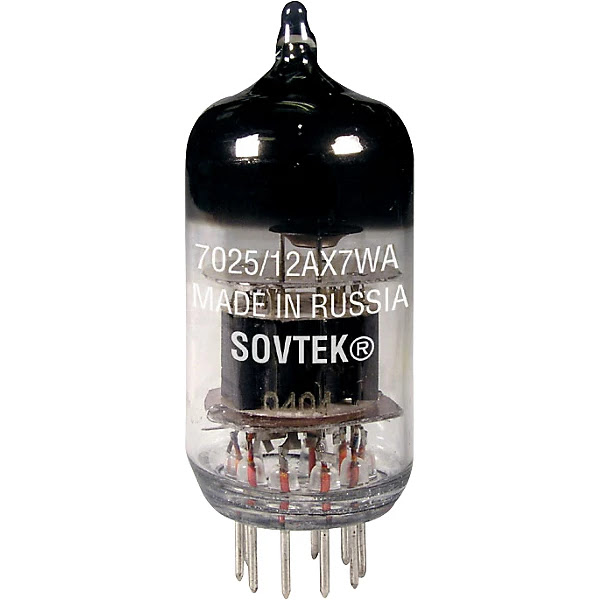
Review: Sovtek 12AX7WA

 I have a love and hate relationship with Russian tubes.  Some of them - like the ECC99 - rival some of the best vintage American and European tubes, while others, like much of the Electro-Harmonix line sounds like solid-state in a bottle.  Yes these tubes can be transparent but they are often lacking in detail or suffer from an aggressive treble and upper midrange.

The early Russian tubes, that first were available in the 1990s to the Western World, were godsend to the tube-o-phile community.  They were cheap and rugged.  An example of this is the 5881WXT which could take the current hungry bias of the Harmon-Kardon Citation V.  Even a RCA blackplate of the era would start to glow on the seams.  But not these Russian mil-spec tubes.

It's been my belief - shared by some friends too - that Russian tubes have good metallurgy but not the best cathode chemistry.  Yes they are rugged, but many of them have the already mentioned issues with the higher frequencies.

As for the Sovtek 12AX7WA, it has a pair of very small coated plates and what I would call a primitive looking spacer that should be made out of mica.  The pins ends are sharp but overall construction looks quite good.  I plugged it into my Frankenstein EICO ST70, which provides the initial gain before the 6SN7 phase-splitter.

The Sound:  Initially I was surprised how much I like the Sovtek.  The sound was very transparent and, at first listen, very modern sounding.  I was reminded of a really good JFET preamplifier or MOSFET amplifier - big, dynamic and smooth.  But, like the aforementioned solid-state gear, lacking in inner detail.  The soundstage was also smeared a bit, removing the space around individual instruments and the big front-to-back sound of a vintage Mullard.  Dynamics in the upper part of the spectrum became a little rough/forced sounding with the Sovtek.

What I'm really finding - at least so far - is that modern tubes often has a good tonal presentation but lack in inner detail and making a big soundstage.  I'm curious to the reason why this is true.  Is this linearity or an artificial presentation brought on by - an unknown variable?  We shall have to continue and have some vintage comparisons.  More later!

Thursday, September 29, 2022

Review: JJ ECC83S short plate 12AX7


To be honest my expectations for this 12AX7 was low.  I haven't had a JJ tube in any of my gear for well over a decade.  Nothing personal, mind you, but back then I was all about more exotic tubes like the C3m, 5687s, EL156s, and whatnot.  JJ has been around since 1994, built on the ashes of Tesla and Ei.  Their small signal tubes aren't mentioned all that much on the forums I visit, or at least I missed the posts.

This particular version of the 12AX7 looks to be based on the famed Telefunken ECC803S, which also had a Tesla copy.  The architecture has small plates that are very similar to a 6DJ8.  This should translate to low microphonics.

As for the sound, at least as the gain tube for a power amplifier, the JJ ECC83S was better than I expected.  There is an overall darkness, making this a good match for some zingier MC cartridges or digital front ends.  This is a "chocolate" expression of the music, with solid and tuneful bass, warm mids, and a high end (to my older ears) that is even less detailed than a Mullard. 

Inner detail with the JJ is less than the long plate Mullard; a slight smearing of instrument and vocal space along with soundstage depth.  Nonetheless at least the JJ sounds like an vacuum tube unlike some of the inexpensive Russian offerings I've heard.  So, much like the TJ and the Psvane, a solid offering but, and your mileage will vary, not exceeding the better old stock versions of the 12AX7 I've heard.

Monday, September 19, 2022

Review: Psvane 12AX7


The Psvane T-12AX7, apparently the base version, is a Chinese design that looks much like a vintage one with gray ribbed plates, quality construction, and steel pins.  The triple-layed mica also looks good.  Bulb size, like so many other new tubes, is slightly larger than my collection of old stock, a mm or two difference in height and circumference..

Break-in was approximately fifty hours as the driver tube in my Frankenstein Eico ST70.  This is basically the classic Mullard 5-20 circuit.  It's been my general experience that the driver tube - before the phase splitter - has a high impact on the overall amplifier sound, more so than the phase-splitter or even the output tubes.

Listening was initially done while reading a book.  There were several times where I had to look up from the pages to truly appreciate what I was hearing.  Like the TJ FullMusic, the Psvane has a great almost vintage tone.  I was hearing little details - an example is Lonnie Liston Smith's Vision of a New World - that I thought weren't apparent to my standard vintage Mullard.  I was beginning to feel some really high hopes for this Psvane.

However some further, more detailed listening, some of it shared with an old audiophile friend with an extensive knowledge of 12AX7s both new and old, began to show some weaknesses.  Though the sound was never muffled, the Psvane, like the TJ, also lacked inner detail and bloom around the instruments.  But wait a minute, you say, where did that extra detail you mentioned go?  It is a strange effect of the Psvane: suppression of reverberation both artificial or natural, pushed some information forward.

Keep in mind this is still the best new production 12AX7 I've heard and I could see use for it in gear or speakers that aren't the most transparent.  The bass was excellent, there was a distinct lack of glare unlike some lesser "solid-state in a bottle" new production tubes.  The midrange was also even as was the treble.  It was just the lack of detail that stopped the Pvane running with the best of the vintage 12AX7s.

Disclaimers: No tube is 100% perfect for all gear.  The only way to be sure how a tube will sound in _your_ system is to hear it.  Also a tube in a phono stage, for example, may have different audio characteristics than say line, input, or phase-splitter use.

 Negative feedback - several dB in this circuit - also reduces the sonic signature of the tube.  An example of this came apparent to me when I built a triode-connected EF86 linestage.  The tube selection - GEC CV4085 and the Mullard "long mesh" were the best - played a big role in the sound quality.  However the EF86 in my Eico HF60 monoblocks were less important, most likely due to the loop negative feedback or perhaps the total number of tubes in play with a more complicated circuit.

 It should also be noted that I am not biased towards vintage tubes.  I really do want a new tube that can compete with the old.

So take this review as a general guideline, not as hard fact.

Review: TJ FullMusic 12AX7


The TJ Full Music 12AX7 is a box plate Chinese design that looks much like a vintage Mullard M8137 and completely unlike any other current new 12AX7 offering.  The gold pins are a nice touch, and it looks like actual mica (?) was used instead of the whatever the heck is used for the Shuguang small tubes.  Bulb size is slightly larger than my collection of old stock, a few mm difference in height and circumference..

Break-in was approximately fifty hours as the driver tube in my Frankenstein Eico ST70.  This is basically the classic Mullard 5-20 circuit.  It's been my experience that the driver tube - before the phase splitter - has a high impact on the overall amplifier sound, more so than the phase-splitter or even the output tubes.   

Tonally the TJ 12AX7 was one of the better new production tubes I've heard so far.  I was initially hard-pressed to hear any difference between it and a quality old tube like a 1950s Mullard.  Bass definition and instrumental shading of the TJ was particularly good, but, even as the hours piled on, I detected a slight muffled sound.  There was a lack - especially compared to the Mullard - of inner detail or instrumental/vocal bloom.  That is to say the TJ had a flatter and smaller presentation.  I'm reminded of an inexpensive cartridge or CD player; the magic "glow" or shimmer, whatever one prefers to call it, was pulled back on the soundstage.

The old Mullard, in comparison, sounded bigger and had better bloom.  The music was more "filled in" with depth and soundstage width.

Do the TJs need more break-in?  I really didn't hear large differences between hour zero and fifty so I remain skeptical.  Nonetheless I did like the TJ tonally, especially compared to some other new production valves I have heard, but I was ultimately disappointed.  I do want new tubes that can perform in the realm of the best of the old.  At least with this tube I'm not hearing it!


Disclaimers: No tube is 100% perfect for all gear.  The only way to be sure how a tube will sound in _your_ system is to hear it.  Also a tube in a phono stage, for example, may have different audio characteristics than say line, input, or phase-splitter use.

 Negative feedback - several dB in this circuit - also reduces the sonic signature of the tube.  An example of this came apparent to me when I built a triode-connected EF86 linestage.  The tube selection - GEC CV4085 and the Mullard "long mesh" were the best - played a big role in the sound quality.  However the EF86 in my Eico HF60 monoblocks were less important, most likely due to the loop negative feedback or perhaps the total number of tubes in play with a more complicated circuit.

So take this review as a general guideline, not as hard fact.

Wednesday, March 23, 2022

Review: A Tale of Two Schiits - Mani 1 vs Mani 2 phono preamp

(photo from Schiit)

I've been using the original Schiit Mani 1 phono preamplifier for some time.  Its sole purpose has been to provide the needed amplification and equalization for my second turntable, the Dual CS5000.  It has done well plugged into the line section of the Audio Research SP8, which has a phono section that is used for the primary turntable, a Thorens TD309.

To be fair, the Mani is a budget phono stage so I could put up with the slight graininess, mid-fi resolution, and the general lower fidelity.  For all the Mani 1's faults, it is still better than a lot of stock phono sections found in budget receivers, preamps, and integrateds.  And given the mostly background music it was used for I had no complaints.

A recent visit to the Schiit Audio site and I saw that a second version of the Mani has been released, this one using a different op-amp and it was also direct-coupled.  The case looks exactly the same but the dip switches on the bottom have changed, allowing more settings for MM and MC cartridges.

To cut to the chase, compared to the old version, the new Mani 2 is more detailed, faster, has better resolution, deeper bass, and higher overall fidelity.  It also images, left-to-right in a fashion that will be most pleasing.  It isn't perfect - nothing is! - but it does swing at a higher than the $149 (black face model) price point suggests.

Where the Mani 2 ultimately fails - compared to the Audio Research SP8 or the Classe Five - is inner detail and that certain "you are there" magic that I've heard with these more expensive units.  The soundstage of the former is also flatter without that depth I've come to expect.   However, to be fair. the Mani 2 does strike awfully close to better preamps making my budget Dual CS5000 sound a lot closer to the combination of Thorens TD309 and the ARC SP8 phono stage.  Depending on your front end, amps, and speakers, this difference may not matter at all.

 As always your mileage may vary depending on your front end, setup, and preferred listening habits.


System:

  • Dual CS5000 with Ortofon OM20 and an aftermarket Shibata stylus
  • Thorens TD309 with Ortofon 2M Bronze
  • Audio Research SP8 with vintage Mullard 12AX7s 
  • Eico ST70 "Frankenstein" amplifier with 6AR6 output tubes
  • KEF R500 speakers
  • MIT interconnects
  • Cardas Twinlink speaker cables


Thursday, September 2, 2021

Short Review: Dynaco A-25 VW loudspeakers


The Dynaco A-25 is a 2-way bass-reflex loaded speaker sporting a 10" woofer and a soft dome tweeter.  I picked up this pair at a half-off day estate sale.  I wasn't, however, expecting much since my experience with vintage speakers has been mixed.

To my surprise, the A-25s really capture the midrange in a nice and pleasing manner.  Yes my (larger) KEF R500s can pump out more bass & treble, do dynamics better, and throw a deeper soundstage; but still these old Dynacos have a certain magic that is hard for me to put my finger on.  Perhaps it is the nice all tubed front end I have, but these vintage speakers are just relaxing to listen to.  They do jazz really, really well; hard rock not as nicely due to their dynamic limitations.

So if you see a pair of A-25s for a good price, check them out.  They would be great in a small system with a low-powered tube or Class A solid-state amp; along with a suitable preamplifier.  They don't do all of the hi-fi tricks of something more exotic, but, like the Dynaco PAS and Stereo 70, capture the midrange depth and bloom a lot better than many, many modern budget components.